- Enterprises
- Tenders
- Courts
- Intellectual property
- For foreigners
- Real estate
-
Translation Bureau
- Translation of documents
- Apostille services in Ukraine
- Apostille services abroad
- Legalization of documents
- Consular legalization for Italy
- Translation and legalization of documents for Spain
- Dichiarazione di Valore
- Examples of Apostille of different countries
- Examples of Consular Legalization for different countries
- Police Clearance Certificate


Interesting facts about Apostille
 21.01.2022
Interesting facts about Apostille
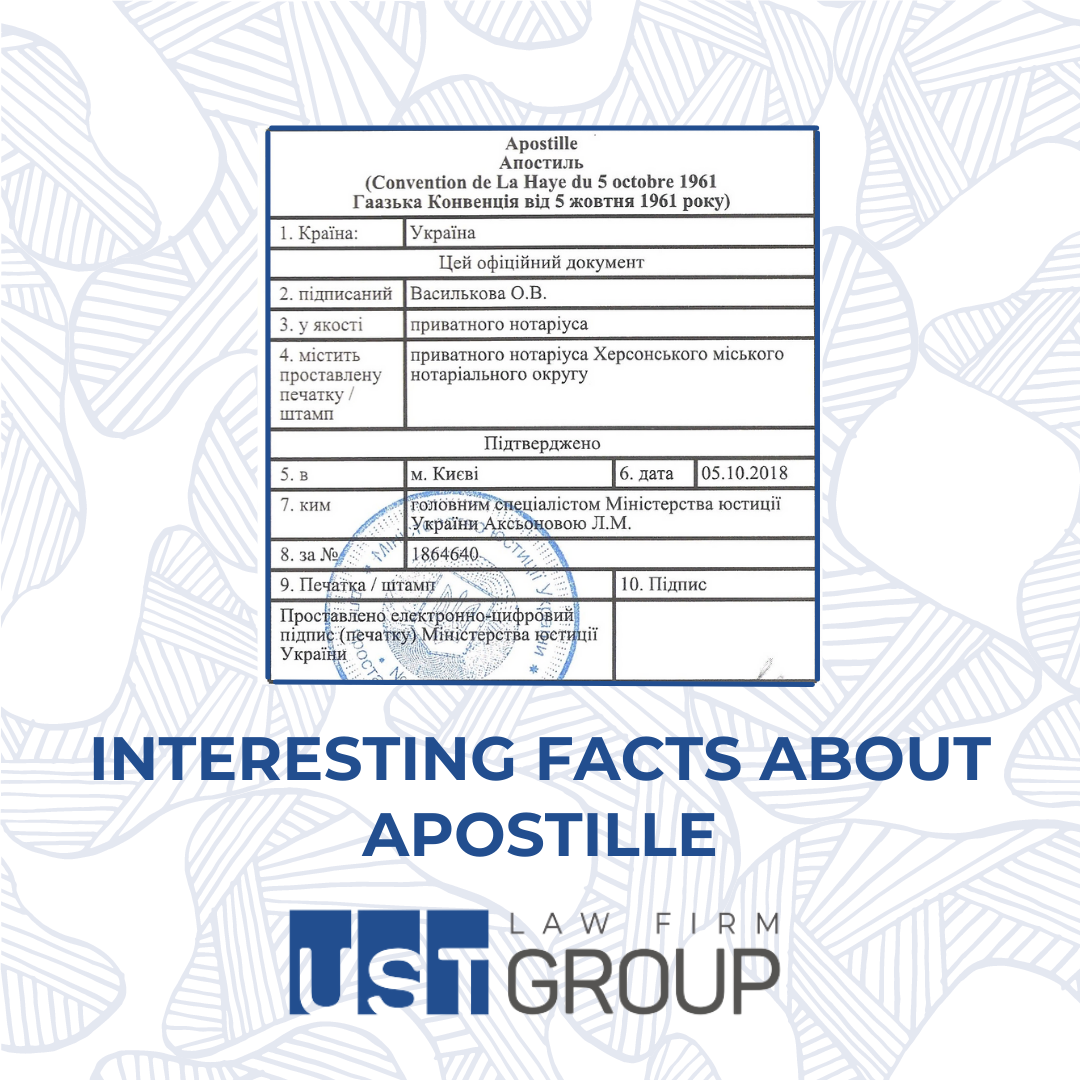
An apostille – an international seal – is necessary to ensure that your documents issued in one country receive legal force on the territory of another country. This seal is accepted in all states that have signed the Hague Convention (EU, CIS, USA and many others).
Due to the increasing mobility of the population, this type of legalization is becoming more and more popular.
What did you not know about the apostille yet?
1. Only the country in which the original document was issued has the right to affix an apostille. For example, a certificate obtained in Ukraine can be apostilled only on the territory of Ukraine.
At the same time, each State determines a narrow circle of institutions in which the relevant procedure is carried out. Each body is responsible only for a certain type of documents (for example, in Ukraine, the Ministry of Education and Science affixes an apostille only on educational documents).
2. The word "apostille" itself has a French origin and an accent on the last syllable. In 1961, during the negotiations on the Hague Convention, it was decided to use the term "apostille" because of the novelty of its sound. This idea was adopted by a majority of votes - 7 against 3, who voted for the term "attestattion", that is, "certifying".
3. Despite the fact that an apostille can be affixed to most official documents, there are some exceptions. Thus, the Hague Convention can be applied to any government documents, except for documents issued by consulates, as well as commercial and customs papers.
UST-group company provides the service of apostille affixing, as well as notarial translation into any language. For consultation, call 044-222-59-73 or contact us via Viber/WhatsApp/Telegram at this number: 063-224-08-18